The Critical Role of Clean Room Doors: Precision, Protection, and Performance
In the world of controlled environments, from pharmaceutical laboratories and biotechnology suites to semiconductor manufacturing plants, every square inch of a facility is engineered for extreme precision. We often focus on high-tech HEPA filters, specialized garments, and stainless-steel surfaces. However, one of the most vital components of a cleanroom’s integrity is often the most frequently used: the door.
A cleanroom door is not merely a point of entry; it is a sophisticated piece of industrial equipment designed to maintain pressure differentials, prevent cross-contamination, and secure the safety of both the product and the personnel.
At Stokes Equipment, we have spent decades helping facilities optimize their controlled environments. By partnering with industry leaders like Rite-Hite, we provide the most advanced door solutions available. In this guide, we will dive deep into the purpose of cleanroom doors, the rising importance of automatic sliding technology, and why choosing the right partner for installation is non-negotiable.
1. Defining the Cleanroom Door: What Makes It Different?
To understand the purpose of a cleanroom door, one must first understand the environment it protects. A cleanroom is a space where the concentration of airborne particles is controlled to specified limits. Whether it’s an ISO 5 or an ISO 8 environment, the goal is to keep “bad” air out and “good” air in.
A standard commercial door fails in a cleanroom for several reasons:
- Surface Porosity: Standard doors often have textures that trap dust and microbes.
- Shedding: Materials like wood or low-grade metal can shed particles over time as they age or sustain impacts.
- Seal Integrity: Standard doors are not airtight, allowing air to leak through gaps at the top, bottom, and sides.
A true clean room door in Pennsylvania, such as those provided by Stokes Equipment, is constructed from non-porous, non-shedding materials like high-grade stainless steel or specialized reinforced polymers. They feature smooth, flush surfaces to prevent dust accumulation and are equipped with advanced sealing systems.
2. The Primary Purposes of Cleanroom Doors
Maintaining Pressure Differentials
Most cleanrooms operate on a principle of positive or negative air pressure.
- Positive Pressure: Used where the product must be protected (e.g., pharmaceutical compounding). Air is pushed out of the room when the door opens, preventing contaminants from entering.
- Negative Pressure: Used when the outside world must be protected from what is inside (e.g., infectious disease research). Air is pulled into the room.
The door’s primary job is to act as a seal that maintains these pressure levels. If a door fails to seal properly, the HVAC system must work twice as hard to maintain the pressure, leading to increased energy costs and a higher risk of environmental “collapse.”
Preventing Cross-Contamination
In facilities with multiple “zones” of cleanliness, doors act as the primary barrier against cross-contamination. High-speed doors minimize the time the “barrier” is open, significantly reducing the volume of air exchange between two rooms.
Managing Air Exchange Rates
Every time a door opens, a “swap” of air occurs. Cleanroom doors are designed to open and close at high speeds (often up to 100 inches per second) to keep the duration of this exchange as short as possible. This helps the facility maintain its ISO rating even during high-traffic shifts.
3. Why Automatic Sliding Doors are the Cleanroom Standard
While roll-up doors are common in industrial settings, Rite-Hite highlights that automatic sliding doors are becoming the gold standard for high-spec cleanrooms. Here is why they are so important:
Reduced Air Turbulence
When a traditional swing door opens, it creates a “fanning” effect, physically pushing air (and potential contaminants) into or out of the room. Sliding doors move along a lateral plane, which creates significantly less air turbulence. This is crucial for maintaining a stable laminar flow within the cleanroom.
Hands-Free Hygiene
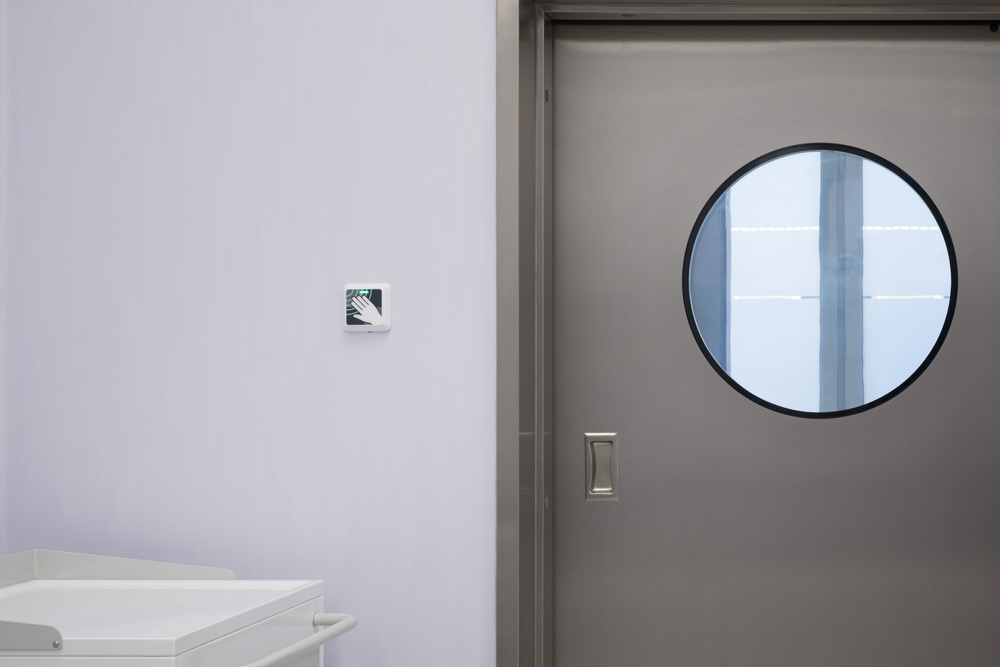
In a sterile environment, touching a door handle is a major contamination risk. Automatic sliding doors utilize wave-to-open sensors or motion detectors. This keeps personnel’s hands on their tasks and off of high-touch surfaces, maintaining the integrity of their PPE.
Space Efficiency
Swing doors require a large “arc” of clear floor space to operate. In expensive cleanroom real estate, every square foot matters. Sliding doors operate within a narrow track, allowing for better equipment placement and easier movement of carts and personnel.
Superior Sealing for ISO Compliance
Advanced sliding doors, like the Rite-Hite models offered by Stokes Equipment, feature “all-around” sealing. When the door reaches the closed position, it often “drops” or “cams” into place to create a near-hermetic seal against the floor and frame, which is essential for meeting strict ISO 14644-1 standards.
4. Key Features to Look For
When browsing the cleanroom door solutions at Stokes Equipment, look for these technical essentials:
- Smooth, Flush Design: Hygiene is paramount. Clean room doors in New Jersey feature “flush” windows and frames, meaning there are no ledges where dust can settle. This makes them easy to “wipe down” during sanitation cycles.
- High-Speed Operation: In a busy facility, slow-moving doors are a liability. High-speed operation makes sure the environment is exposed for the minimum time necessary.
- Break-Away and Self-Repairing Tech: In the event of an accidental impact (such as a cart hitting the door), specialized doors are designed to “break away” from their tracks without damage. Many models are “self-repairing,” automatically re-feeding into the tracks on the next cycle.
5. Why the “Total Cost of Ownership” Matters
When purchasing a cleanroom door, it is tempting to look only at the initial sticker price. However, a “cheap” door often ends up being the most expensive asset in the building due to:
- Energy Loss: Poor seals lead to massive HVAC bills.
- Maintenance Downtime: If a door fails, the cleanroom may have to be decommissioned until it is fixed, costing thousands in lost production.
- Regulatory Fines: If an inspector finds that your doors are shedding particles or failing to maintain pressure, your entire operation could be halted.
Investing in a premium door through Stokes Equipment guarantees that you are getting a product designed for longevity, reliability, and compliance with FDA and ISO standards.
6. Stokes Equipment: Your Cleanroom Experts
Choosing the right door is only half the battle; the other half is expert installation and ongoing maintenance. This is where Stokes Equipment excels. We provide a level of expertise that general contractors simply cannot match.
Consultation and Customization
No two cleanrooms are the same. Our team works with you to evaluate your specific pressure requirements, traffic flow, and sterilization protocols. We don’t just sell you a door; we provide a solution tailored to your facility’s ISO classification.
Professional Installation
In a cleanroom, a fraction of an inch matters. Our technicians are trained in the nuances of controlled environment installations. We guarantee that every seal is airtight, every sensor is calibrated, and every “break-away” feature is tested.
Preventive Maintenance and Rapid Service
A cleanroom door is a mechanical device that requires care. Stokes Equipment offers comprehensive preventive maintenance programs to catch wear and tear before it leads to a failure. Should a problem arise, our local service teams respond quickly to minimize your facility’s downtime.
7. The Importance of Compliance: FDA and ISO Standards
For industries like pharmaceuticals and medical device manufacturing, doors are part of the “validated” environment. The doors provided by Stokes Equipment are designed to meet:
- USDA/FDA Requirements: Using materials resistant to heavy wash-down chemicals.
- cGMP (Current Good Manufacturing Practice): Supporting a repeatable, controlled manufacturing process.
- ISO 14644-1: Make sure the door does not contribute to particle counts within the room.
8. Conclusion: Protecting Your Investment
Your cleanroom represents a massive investment in technology, research, and production capability. Don’t let a sub-par door be the weak link in your chain.
The purpose of a cleanroom door is multifaceted: it is a seal, a shield, a regulator, and a gateway. By prioritizing high-speed operation, automatic sliding technology, and professional installation, you secure the safety of your products and the efficiency of your operations.
Whether you are building a new facility or looking to retro-fit an existing controlled environment, the experts at Stokes Equipment are here to help. Contact us today and take the first step toward a more secure, efficient, and compliant facility.